A Short History of Designing Otherwise[1]
Design research studies design: how people design, what designed things do in the world, and how designing itself produces knowledge. It emerged as an academic field in the 1960s, when designers and engineers began studying design methods, and has since broadened from products and buildings to services, systems, policies and everyday practices. A common distinction separates research about design (studying it from the outside, as historians or sociologists might), research for design (gathering knowledge to inform a design), and research through design (where making, prototyping and experimenting are themselves ways of finding things out).[2] This last idea makes the field distinctive: knowledge can come from making, not only from observing or writing.
Design research thus studies how designing intervenes in the world and, in doing so, shapes it, sustaining certain objects, systems and ways of living, thinking and doing, while leaving others out. Designing is neither neutral nor detached from wider socio-political structures. Having grown alongside colonial and industrial expansion, design has often carried a single Western idea of progress, function and problem-solving, treating other ways of knowing and making as craft, tradition or raw material.
This is where design and decolonisation meet: in questioning that inheritance and contesting the colonial assumptions in design’s practices, theories, education and institutions.[3] Whose knowledge counts as design, and who decides? Whose futures does design make possible, and whose does it close off?
While people at the margins have designed otherwise for millennia, the dominant Western, white, centre-periphery idea of design changed little until a broader critique of the colonial roots of modern knowledge began to resonate in the field. That critique emerged from older struggles. Decolonisation first named a political process: the end of empires and the independence of colonised nations, peaking in Africa and Asia in the 1950s and 1960s. Yet, as the anti-colonial thinkers Aimé Césaire and Frantz Fanon showed, independence did not end colonialism’s hold on minds, languages and institutions, an idea Ngũgĩ wa Thiong’o later developed in Decolonising the Mind (1986).[4]
In Latin America, the critique had its own, earlier roots. As early as 1928, José Carlos Mariátegui traced Indigenous subordination to land dispossession, framing the colonial question from the Andes.[5] In the 1960s and 1970s, Paulo Freire and Orlando Fals Borda turned the critique towards knowledge itself. Freire’s critical pedagogy showed how education taught the oppressed to see the world through their oppressors’ eyes, and proposed learning from people’s own experience; Fals Borda’s participatory action research enabled communities to investigate and act on their own situation rather than merely provide data.[6] In Bolivia, Silvia Rivera Cusicanqui’s work with Aymara oral history, condensed in the title Oprimidos pero no vencidos (”Oppressed but not defeated”, 1984), placed Indigenous memory and struggle at the centre of knowledge.[7]
Building on these ideas, Aníbal Quijano coined ”coloniality” in the early 1990s: the colonial hierarchies of race, labour and knowledge that persist after independence. Under the coloniality of knowledge, European knowledge became universal, and other knowledges mere belief or superstition. Walter Mignolo developed the idea further, and Catherine Walsh, working from Ecuador with Indigenous and Afro-descendant movements, extended it to interculturality and pedagogy.[8] Together they shaped what became known as the decolonial turn, though Rivera Cusicanqui warned it risked becoming an academic fashion detached from the struggles it drew on.[9]
Decolonial thought pushed design research to examine its monolithic and extractive inheritances, though only explicitly in recent years. Precursors came earlier. In the 1960s and 1970s, Lina Bo Bardi and Aloísio Magalhães in Brazil presented o popular (the everyday making of the people and the working classes) as design knowledge rather than folklore,[10] and Gui Bonsiepe, working in Chile and Argentina, wrote about design in the periphery[11] and Latin America’s technological dependency. In 1979, the Ahmedabad Declaration in India called for design rooted in local needs rather than imported models.[12]
At the same time, in the North, critics denounced design’s complicity in consumerism,[13] and Scandinavian participatory design brought democratic questions of who decides into design practice. Paradoxically, this celebrated Northern tradition owes much to anti-colonial thinkers, a debt the field has often overlooked.[14] Freire’s pedagogy, for instance, informed the 1970s Scandinavian worker co-design movement; one of its pioneers recalled Freire’s 1972 visit to Stockholm.[15] Together with Fals Borda’s participatory action research, this lineage challenged the colonial gaps between theory and practice, and between researcher and researched, recasting knowledge as something created in dialogue with knowledgeable communities to transform the conditions they live in.
Decolonisation became a named agenda in design research mainly in the 2010s. In 2013, Elizabeth (Dori) Tunstall called for decolonising design innovation through design anthropology and Indigenous knowledge,[16] and in 2016 the Decolonising Design group formed, followed by a special issue of Design and Culture in 2018.[17] That same year, Arturo Escobar’s Designs for the Pluriverse linked design to Latin American decolonial thought, borrowing the Zapatista call for ”a world where many worlds fit” to shift design from one future for everyone to many.[18] Participatory design research moved in the same direction, extending its practices into non-Western and community-based contexts. Its main conference, long held in the North, met in Namibia (2014), Colombia (2020) and Malaysia (2024), problematising participation from the margins and learning from Indigenous knowledge and methods.
Today, these concerns form a dynamic strand of design research, gathered around ideas such as decolonising design, designing otherwise, pluriversal design, and design and oppression. Much of it comes from an increasingly diverse community of researchers and practitioners working from their own situated knowledges. It arrives in deeply polarised times yet nourished by social movements and by communities with long experience of resistance. But as decolonisation spreads through the field, it risks becoming a trend word, ticked off in events, funding calls and projects without creating the conditions for the discipline to engage with other ways of knowing, shaped by unequal histories. In a roundtable on what is at stake in decolonising design, Danah Abdulla compares this to the path of ”sustainability”, a word placed in front of anything and emptied of its urgency, as in ”I’m going to decolonise my breakfast”.[19]
Decoloniality is not only about Indigenous peoples, though it is deeply intertwined with their struggles over land, sovereignty and their own knowledges. Because coloniality is a global matrix of power, its reach extends beyond territorial colonisation, affecting communities shaped by persistent Eurocentric patterns of power, knowledge and being: Indigenous peoples, formerly colonised nations, peasant and popular sectors from different Souths, Afro-descendant peoples, and peoples living under occupation, as in Palestine. In this essay I focus on Indigenous peoples, the communities I work with. While wary of turning decolonisation into a loose metaphor for social justice, I also consider why this work matters for wider societies.
With this ground laid, I turn to my own path. If knowledge can come from the act of making, and colonial assumptions run through design’s practices, theories, education and institutions, then my own design education and practice are places to examine and challenge them. I write from there, not from the so-called ”god trick” of seeing everything from nowhere,[20] but from a layered somewhere: the histories, experiences and territories that cross me. I am a design researcher at a Nordic university, where resources and recognition concentrate. I work with Indigenous youth and organisations in the Ecuadorian Amazon on participatory research and design, in long-term, committed relationships. And I am a Latin American mestiza woman from Ecuador, with both Indigenous and coloniser ancestry. These positions do not sit comfortably together, and that discomfort is where my reflections come from. What follows is my own situated, experiential account of the relationship between design research and decolonisation.
What We Learn Not to See
I begin with the most personal and everyday. When I began studying design, the dominant references came from Western Europe and the English-speaking world. The standard was to internalise the Swiss grid system, Bauhaus functionalism, Mies van der Rohe’s ’less is more’, Dieter Rams’s principles of ”good design” and design thinking from California. Outside the classroom, the popular design imaginary followed the same map: American branding, Nordic interiors, Apple’s minimal devices, advertising where whiteness was the default, and Italian, French and Swiss design products.
These were not the only references. Other worlds of design, rooted in our histories and territories, were part of our everyday lives: toquilla straw hats, woven from palm fibre by Ecuadorian weavers, known abroad as ”Panama hats”; popular graphics, such as hand-painted street signs by rotulistas; Amazonian mucawas, drinking bowls made and painted by Kichwa women with designs linked to the forest, rivers and dreams. Yet these entered heritage lists and craft markets, not design history. The European and Anglo references were the most pervasive, the most official and the most aspirational, in the classroom and beyond. That is everyday coloniality: the quiet way design projects and sustains dominant historical structures. Bolívar Echeverría called this blanquitud (whiteness): not a matter of phenotype, but the ethos of capitalist modernity that whiteness signals, its imperative of efficiency and productivity, its ”civilised” taste in aesthetics and manners.[21] It is a more ”tolerant” racism than ethnic whiteness, a set of practices anyone can, and is expected to, adopt in order to embody patriarchal, extractive-capitalist, colonial modernity.

This promise of modernity through dominant norms has a long history in Latin America through mestizaje[22]. After independence, many Latin American states, Ecuador among them, made mestizaje the national identity. It was presented as harmonious mixing, but it often worked as blanqueamiento, a whitening project: being mestizo meant moving away from Indigenous and local roots and towards Eurocentric norms. Education, design education included, carried this project forward. These mechanisms are not confined to Latin America. As my studies continued in Europe, I recognised them again in other forms and under other names: in the references that count as canonical, and in the knowledges treated as context rather than theory. They are part of how academic knowledge is organised more broadly, and they are increasingly being questioned from within.
In this sense, I hear echoes of Sámi professor Harald Gaski, who reflects: ”It took me 20 years to find out what consequences the education I was given had for me. […] I think it was after the introduction of Indigenous methodologies, we dared to start looking at our own values even in an academic setting. Then we also started to use Sámi concepts for describing Sámi experiences. In a way it opened the path to being more philosophical and critical towards the education that we had received and what that really did to our minds.”[23] As a Latin American and a mestiza, I am both subject to colonial hierarchies and, relative to Indigenous peoples, privileged by them. I am not equating my education with Gaski’s or with Indigenous experiences of schooling that, in Finland too, was meant to make Sámi children Finnish. What resonates is the recognition of how deeply colonisation, and the education and academia shaped by it, determine what we value, and what we learn not to see.
For me, then, decolonising design research begins with a critical look at design education and academia, and the unpicking of an embodied history of coexisting and often conflicting inheritances, through practices shared by many who work with and from the margins.
This begins with positionality: stating one’s social, political and cultural position openly, so that its influence on the research, the practice and the designs becomes visible and open to discussion and change. It takes the form of reflections, accompanied by actions, revisited at different moments and from different perspectives. It continues in the selection of references: deliberately centring Southern, Latin American, Indigenous and other marginalised sources, academic or not, to reactivate situated histories of work that are often overlooked. Any reading list or reference board can be read this way: which places and peoples does it let us think with, and which does it leave out?
The same applies to teaching. As design questions its colonial legacies, teaching can bring diverse design cultures and methods into classrooms and academic spaces as knowledge rather than exotic examples, and widen the spaces for listening to them, asking whose knowledge is taught as theory, and whose only as a case? As for writing, theorising otherwise can mean mixing argument, history, politics and personal voice. This has a long tradition in the Latin American essay, and it resonates with oral accounts, testimony and making. Yet these are often dismissed as essayistic, anecdotal or craft, and treated as particular, while positivist approaches count as universal. Writing this way claims them as theory. After all, if colonialism is at once economic, cultural and intimate, can it be understood through writing that keeps these apart?
Much of this work is about making things visible, what needs to be challenged and what needs to be sustained, because we cannot struggle against, or sustain, what we cannot see. Visibility helps create an intersubjectivity of knowledge, where communities see themselves represented and ways of designing can be valued across communities. Those at the centres, educators and institutions especially, have a role here: not speaking for others, but supporting the conditions for these knowledges to be taken seriously. This means understanding decoloniality, in Danah Abdulla’s words, as ”a subversion and transformation of Eurocentric thinking and knowledge; a knowledge produced with and from rather than about”.[24] What is at stake is a wider problem: a geographical reduction that overlooks knowledge from the margins or, at best, confines it to the local and not generalisable,[25] narrowing what we can all learn from the range of human knowledge.
Who Designs, Who Benefits, What Returns
Efrén Nango, a Shiwiar leader, and Lizbeth Tanguila, a Kichwa youth representative, had travelled from the Ecuadorian Amazon to Helsinki to present our joint research at a conference. Luis Vargas Canelos, an Achuar elder and leader, was also in the city. Walking together the day before, we passed a poster advertising an ayahuasca[26] healing retreat in Germany. I asked them what they thought of it. Vargas noted at once how the poster reduced a complex sacred practice to a paid experience. Efrén and Lizbeth found the exotic visuals unrepresentative but, more importantly, doubted the event had any connection to land: how was this ”experience” giving back to the Amazon?
Nina Gualinga, a Kichwa woman and land defender from the Ecuadorian Amazon, makes the same point in her short documentary Waska: The Forest is My Family and in an accompanying article with Eli Virkina. Behind wellness programmes, they argue, lies an ongoing story of commodification and extraction, in which healing is sold as a simplified, marketable experience, detached from the communities, territories and reciprocity that sustain the plant and its knowledge.[27] The poster is one small instance of a structural practice, epistemic extractivism, discussed below. Indigenous knowledge is rooted in place. Like modern science, Gualinga says, it rests on observation, but observation made through long relationships between people, forests and all beings, and through deep social and environmental responsibility. Without that responsibility, it becomes another form of colonialism dressed in spiritual language.
Design and design research can be dressed up in the same way, in the language of diversity, participation or inclusion, while disconnecting design processes and products from the questions of who designs, who benefits, and how knowledge and practices return to communities. The Lakota graphic designer Sadie Red Wing points to brands that lift Native patterns without understanding them, mixing symbols from one region onto products about another, and calls instead for visual sovereignty.[28] Behind this lies a familiar hierarchy: Indigenous visual work is treated as raw material, a resource to be used, rather than as design on its own terms. The Sámi design student Lotta Hagelin documents similar cases in the Nordic countries. In Finland, costume-shop imitations of the gákti, traditional Sámi clothing, have been worn by Miss Finland contestants and, in 2014, by the alpine skier Tanja Poutiainen at her farewell race, while souvenir shops in Lapland sell mass-produced ”Sámi” goods. More recently, the Swedish brand Acne Studios presented ”its own take” on the traditional Sámi beak shoe.[29] For Sámi people, the gákti is not a costume but an important marker of identity and community, a garment that carries family, place and history.
The relationship between design research and decolonisation can be seen as one of involving marginalised communities, foregrounding other ways of seeing, thinking, educating, writing, making and knowing through design. Inclusion, however, is not enough. As the examples above show, it can perpetuate dispossession. In research, this has a more precise name: epistemic extractivism, the process by which ideas, practices and knowledges are taken from communities and removed ”from the contexts in which they were produced in order to depoliticise them and give them new meaning through Western-centric logics”, often to be appropriated ”within the Western academic machinery in order to gain symbolic capital”.[30] It is a form of colonisation because it applies to knowledge the same logic as the colonial extraction of land and resources.
Researching about communities affected by coloniality is not decolonising. What matters is whether the relationship becomes one of real dialogue and exchange: one that learns from how their knowledges are rooted in place and history, while supporting their struggles. Gualinga makes this point sharply: she sees extractivism at work when people seek healing through Indigenous medicines while ignoring the lives of those who protect the plants, the knowledges and the territories they come from, communities still resisting mining, oil extraction and agribusiness. For her, true healing must include justice, reciprocity and solidarity with these peoples and their lands.
Learning to Design with
What might justice, reciprocity and solidarity look like in design research? It is a question I negotiate, with its tensions, in my own design practice with Indigenous youth. Pictogramas de Nacionalidades Amazónicas del Ecuador (Pictograms of Amazonian Nationalities of Ecuador, 2020–present) is a long-term project in which young people create sets of images that represent their concepts, practices and knowledges from their own perspectives.[31] The designs do not aim for efficiency, standardisation or minimalism; they make space to weave together complex themes of Indigenous life. In this way, the pictograms support the right of Indigenous peoples to define their own visual language and how they are represented, while their collective design process builds knowledge anchored in the relationships and territories of the communities involved. Sustaining this over time brings us back to the three questions raised earlier, and to some approaches we are still learning from.
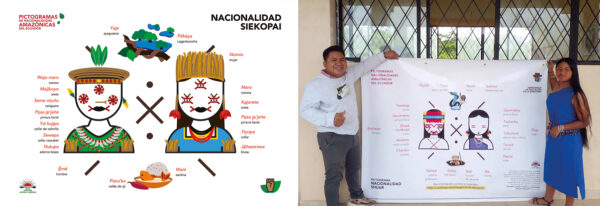
Who designs? The work is community-led and distributed. Indigenous youth and leaders make the decisions and shape the research throughout, while everyone, including me, takes on shifting roles as the work changes: taking notes, designing, interviewing community members, and presenting at academic venues and on Indigenous platforms.
Who benefits? Within dominant structures, benefits do not flow to communities by default; they have to be deliberately redirected. People are properly credited. Where possible, youth and their organisations are named rather than anonymised, a collective decision to make their work visible as spokespeople of their territories. We look for ways to fairly compensate knowledge bearers, even when funding rules recognise only experts with university degrees, and we push for those rules to change. We also discuss what counts as recognition and how to share it. For the youth, a co-authored article may weigh less than presenting their research to Indigenous organisations at the annual regional Amazonian assembly.
How does knowledge return? Time and conditions are actively made for the research to respond to communities’ strengths and needs, in their own formats. The youth work in their Indigenous languages, with Spanish as the shared language of the research collective, and the same research is published in academic journals and in local and Amazonian Indigenous outlets. At the collective’s suggestion, the pictograms are mobilised for education, communication and political action within ongoing resistance, on banners in protests against mining or as teaching material in intercultural schools.
Researching through design, building knowledge through making, can support decolonisation as a process. This is not decolonisation as a quick prefix, but an ongoing contestation of an ever-present coloniality. When designing with others, Indigenous peoples and beyond, by making drafts, visuals, garments, devices, prototypes, maps, services and processes in ways that foreground embodied, material and territorial knowledges, and working through the tensions between practical politics and academic scholarship, design becomes a site of contestation. This matters because design reproduces material culture, and with it concepts, methods, media and tools. It can serve colonial, capitalist and centre-driven agendas. Yet, as the decolonial thinker Madina Tlostanova argues, design can also transform social and cultural reality, shaping how we live and who we become.[32] In this sense, it can be a powerful tool for making room for a pluriverse of world-makings.
This is my oscillating, but hopeful, view of the relationship.
Decolonising from the Centre?
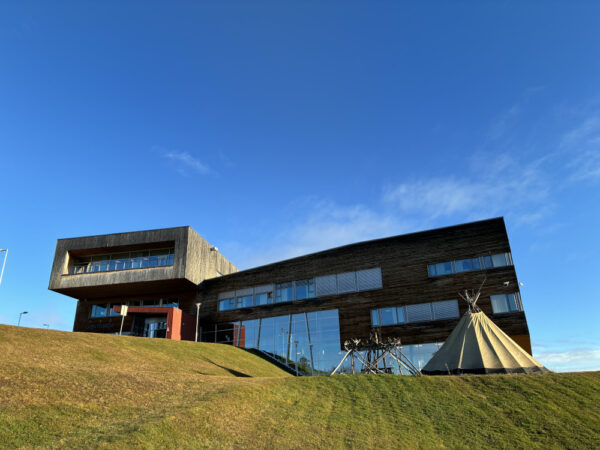
On a recent visit to the Sámi allaskuvla (Sámi University of Applied Sciences) in Guovdageaidnu, Norway, for a conference, I learnt from a solid body of work built on Sámi research methodologies and attentive to their present and future applications, especially in education. Knowledge and teaching are located on Sámi land, the faculty is Sámi, and the academic building sits in dialogue with Sámi architecture, with a lávvu, a traditional Sámi tent whose design and local materials reflect Sámi values of practical knowledge, adaptation and self-reliance, standing in front of the university. These socio-material infrastructures allow Sámi knowledges to unfold on their own terms, alongside practices and knowledges beyond institutions, where other worlds have been continuously made in resistance.
Indigenous institutions like this are essential: they uphold the right of peoples to their own education. Similar needs exist for other colonised and oppressed groups; in the post-colonial South, for instance, more universities are needed that are rooted in the lived realities of local and popular sectors. Conventional universities, however, cannot leave the work of decolonising to these institutions. This raises a question for those of us at the centres, whether in capitals and main cities, in Western-oriented universities in Europe and the Anglo world, or in institutions elsewhere that reproduce centre-periphery relations: can design research be decolonised from within the conventional university?
It has been argued that universities are themselves products of national, imperial, colonial and capitalist histories. They can never be fully decolonised, but they can and must undertake an engaging, challenging, and relentless process of decolonisation, not least because they have the means to do so.[33] Coloniality generates many kinds of knowledge inequality, exacerbates them through exclusionary frameworks, and mobilises universities to maintain them. Yet universities also have the means to change. They concentrate power and resources, in people, infrastructure and funding, and are well placed to take on the critical work that decolonisation asks of them. Some have already begun, through more diverse curricula and new forms of collaboration; whether such efforts lead to lasting change depends on sustaining them over time.
The university, then, is not neutral ground but part of the structure to be challenged. Here I follow the Quechua scholar of Indigenous studies and education Sandy Grande, whose essay ”Refusing the university” calls not for a choice between reforming the university and leaving it, but for collectivity, reciprocity and mutuality between Indigenous and Black communities, acting ”within, against, and beyond the university”.[34] Refusal, in this sense, is not only saying no; it also means asserting other forms of justice and relation. I would argue it is a practice open to all academics and the different communities affected by coloniality.
In design research, the Brazilian Design & Oppression network offers a useful way to think about such alliances. Drawing on Freire, Sâmia Batista e Silva, one of its members, sees solidarity as an alliance in struggle. Designers stand alongside oppressed groups to understand and confront the causes of oppression, rather than reducing them to a design problem to be solved. This shifts where change comes from: it is not design that frees people from oppression, but practices of resistance that inspire new ways of theorising and practising design.[35] Communities’ resistance leads, and design learns from it. Crucially, because decolonisation in design research takes shape through land-based work and relationships, solidarity means decentralising what universities concentrate, their resources and recognition, towards the communities they work with.
Decolonising Design Research: Solidarity, Not Charity
Written from a situated position, this essay is an exercise in tracing the relationship between design research and decolonisation across three scales. It begins by reflecting on my mixed heritage and design education, to foreground the importance of making visible both what needs to be challenged and what needs to be sustained. It then turns to the discipline as a collective practice, where decolonising means designing with communities: building knowledge through making together rather than extracting it. Finally, it problematises the university as a place for decolonisation, to show that decolonising is multi-sited work that depends on activating academic solidarities.
Solidarity, not charity: decolonisation in design research is not something done for others. The struggles of marginalised communities over land, knowledge and the right to define themselves are not only theirs; they concern what all of us can know, value and become. When some ways of knowing are dismissed or extracted, we are all left with less to think with, at a time when an unequal world in crisis needs more ways of knowing, not a monolithic one.
Buen vivir (good living), the Spanish rendering of the Kichwa sumak kawsay, is one example of what this can mean. Joining Indigenous traditions with critiques of modernity, it’s a philosophy of life and political project that challenges a colonial model of development that treats nature as a resource, not a living whole that includes human beings. The Kichwa academic Bolívar Yantalema describes sumak kawsay as the communal capacity to sustain and renew life for present and future generations, shaped by each community’s territory and problems.[36] Carried into national politics by the Indigenous movement, joined by other sectors and actively supported by intellectuals, it shaped Ecuador’s 2008 constitution: living well for all, Indigenous or not, rather than growth, became the purpose of the state, and nature a subject of rights.[37] Despite tensions with extractive policies, it set a precedent beyond Ecuador, from Bolivia to Colombia and New Zealand,[38] and has inspired new approaches to research, from the wider academy to design.[39]
Sumak kawsay shows how knowledge systems change when struggles meet: solidarity does not only support other ways of knowing, it is reshaped by them. Other realities cannot be built with the same knowledge and practices that sustain an oppressive world system. The relationship between decolonisation and design research therefore rests on work that is never finished: supporting the knowledges of those at the margins on their own terms, so that what is learnt together returns to them and contributes to living well for all.
Text: Nathaly Pinto
Images: Lù Chén, Nathaly Pinto
Notes and References
[1] This short history keeps to the references I know best, mainly from the South, especially Latin America, and leaves out important contributions from Asia, Africa and elsewhere. It builds partly on chapter 1 of my doctoral thesis: Pinto, N. (2025). Participatory design for resistance: The making of pictograms with Indigenous youth in the Ecuadorian Amazon. https://aaltodoc.aalto.fi/participatorydesignforresistance
[2] Frayling, C. (1993). Research in art and design. Royal College of Art Research Papers, 1(1), 1–5.
[3] In this essay I use decolonisation for the broad, ongoing process of undoing colonial relations of power, land and knowledge. Related terms come from different traditions and political orientations. Decolonial thought emerged in the 1990s from Latin American and Caribbean scholars and centres on coloniality. Anti-colonial thought grew within mid-twentieth-century liberation struggles in Africa and the Caribbean. Postcolonial theory, developed from the late 1970s mainly by South Asian and Middle Eastern scholars and focused on the cultural legacies of empire, is not discussed here.
[4] Césaire, from Martinique, and Fanon, from Martinique and active in the Algerian liberation struggle, wrote at the height of anti-colonial movements. Ngũgĩ, from Kenya, later stopped writing fiction in English and turned to Gĩkũyũ. Césaire, A. (2000). Discourse on colonialism. Monthly Review Press. (Original work published 1950); Fanon, F. (1963). The wretched of the earth. Grove Press. (Original work published 1961); Ngũgĩ wa Thiong’o. (1986). Decolonising the mind: The politics of language in African literature. James Currey.
[5] Mariátegui was a Peruvian journalist and Marxist thinker. He read Andean communal life, the ayllu, with its reciprocity and solidarity, as a basis for social transformation. Mariátegui, J. C. (1928). Siete ensayos de interpretación de la realidad peruana. Biblioteca Amauta.
[6] Freire, P. (1970). Pedagogy of the oppressed. Herder and Herder; Fals Borda, O., & Rahman, M. A. (Eds.). (1991). Action and knowledge: Breaking the monopoly with participatory action-research. Apex Press.
[7] Rivera Cusicanqui, S. (1984). Oprimidos pero no vencidos: Luchas del campesinado aymara y qhechwa de Bolivia, 1900–1980. Hisbol; CSUTCB.
[8] Quijano, A. (1992). Colonialidad y modernidad/racionalidad. Perú Indígena, 13(29), 11–20; Mignolo, W. D., & Walsh, C. E. (2018). On decoloniality: Concepts, analytics, praxis. Duke University Press.
[9] Rivera Cusicanqui, S. (2012). Ch’ixinakax utxiwa: A reflection on the practices and discourses of decolonization. South Atlantic Quarterly, 111(1), 95–109. https://doi.org/10.1215/00382876-1472612. She criticises the academic decolonial network, largely based in US universities, for drawing on Andean and Indigenous thought without acknowledging its sources.
[10] Bo Bardi, an Italian-born architect, gathered Brazilian popular objects in the exhibition A mão do povo brasileiro (”The hand of the Brazilian people”, 1969). Magalhães, a designer, founded Brazil’s National Centre for Cultural Reference in 1975. Bo Bardi, L. (1994). Tempos de grossura: O design no impasse. Instituto Lina Bo e P. M. Bardi; Magalhães, A. (1985). E triunfo? A questão dos bens culturais no Brasil. Nova Fronteira.
[11] Between 1968 and 1973, Bonsiepe worked in Chile, where he led the industrial design group of the state technology institute (INTEC) under Salvador Allende’s government, including the operations room of Project Cybersyn. Bonsiepe, G. (1985). El diseño de la periferia: Debates y experiencias. Gustavo Gili.
[12] Balaram, S. (2009) Convened by UNIDO with ICSID and India’s National Institute of Design, the meeting urged designers to seek ”local answers to local needs”. Design in India: The importance of the Ahmedabad Declaration. Design Issues, 25(4), 54–79. https://doi.org/10.1162/desi.2009.25.4.54.
[13] Papanek, V. (1971). Design for the real world: Human ecology and social change. Pantheon Books.
[14] Winschiers-Theophilus, H., Smith, R. C., Van Amstel, F. M. C., & Botero, A. (2024). Decolonisation and participatory design. In Routledge international handbook of contemporary participatory design (1st ed.) (pp. 111–137). Taylor & Francis.
[15] Ehn, P. (2018). Design, democracy and participation: Exploring the Scandinavian participatory design tradition [Lecture]. http://archive.org/details/pelle_ehn_participatory_design_100_years
[16] Tunstall, an African American design anthropologist, became in 2016 the first Black dean of a faculty of design, at OCAD University in Toronto. Tunstall, E. (2013). Decolonizing design innovation: Design anthropology, critical anthropology, and indigenous knowledge. In W. Gunn, T. Otto, & R. C. Smith (Eds.), Design anthropology: Theory and practice (pp. 232–250). Bloomsbury.
[17] Members included Danah Abdulla, Ahmed Ansari, Ece Canlı, Mahmoud Keshavarz, Matthew Kiem, Luiza Prado de O. Martins, Pedro J. S. Vieira de Oliveira and Tristan Schultz. See Design and Culture, 10(1), 1–6. https://doi.org/10.1080/17547075.2018.1434367
[18] Escobar, A. (2018). Designs for the pluriverse: Radical interdependence, autonomy, and the making of worlds. Duke University Press.
[19] Schultz, T., Abdulla, D., Ansari, A., Canlı, E., Keshavarz, M., Kiem, M., Martins, L. P. de O., & Vieira de Oliveira, P. J. S. (2018). What is at stake with decolonizing design? A roundtable. Design and Culture, 10(1), 81–101. https://doi.org/10.1080/17547075.2018.1434368
[20] Haraway, D. (1988). Situated knowledges: The science question in feminism and the privilege of partial perspective. Feminist Studies, 14(3), 575–599. https://doi.org/10.2307/3178066
[21] Echeverría, an Ecuadorian-Mexican philosopher, distinguished blanquitud, an ethos of modernity, from blancura, ethnic whiteness. Echeverría, B. (2010). Modernidad y blanquitud. Era.
[22] Mestizaje is the mixing of Indigenous, European and African peoples and cultures that began with colonisation in Latin America. After independence, states made it the core of national identity. Presented as unity, it worked to assimilate Indigenous and Black identities. It shaped citizenship, land, economy, gender roles and even feelings of national belonging.
[23] MacNeil, K. S., & Gaski, H. (2026). On Sámi and Indigenous peoples’ connections to land. Ethnologia Scandinavica, 56, 43–55.
[24] Abdulla is a Palestinian-Canadian designer and educator, and a founding member of the Decolonising Design group. Abdulla, D. (2020). Imagining otherwise. In Decolonizing: The curriculum, the museum, and the mind (p. 88). Vilnius Academy of Arts Press.
[25] The pattern is well documented: the North produces theory, the South supplies cases. See Connell, R. (2007). Southern theory: The global dynamics of knowledge in social science. Polity. Others have turned the question around, asking what theory looks like when it starts from the South: Comaroff, J., & Comaroff, J. L. (2012). Theory from the South: Or, how Euro-America is evolving toward Africa. Paradigm.
[26] Ayahuasca is a hispanicised name for a plant-based medicine used in ceremonial and healing practices, mainly by Indigenous peoples of the Amazon basin, who know it by many names, such as natem among the Shuar and Achuar, and yajé among the Siekopai.
[27] Gualinga, N., & Virkina, E. (2025, June 17). ”Ayahuasca tourism” is a blight on Indigenous peoples and our environment. The Guardian. https://www.theguardian.com/commentisfree/2025/jun/17/ayahuasca-tourism-indigenous-peoples-environment-pyschedelics-biodiversity-ecuador; Gualinga, N. (Director). (2025, June 17). Waska: The forest is my family [Video]. The Guardian. https://www.youtube.com/watch?v=8jG6B0o1QfQ
[28] Red Wing, S. (2017, May 17). Decolonizing Native American design. Communication Arts. https://www.commarts.com/columns/decolonizing-native-american-design; Red Wing, S., Southall, N., & Tunstall, E. (2016, October 18). Respectful design: Decolonization as an urgent imperative [Conference talk]. AIGA Design Conference. https://www.aiga.org/inspiration/talks/sadie-red-wing-neebinnaukzhik-southall-dori-tunstall-respectful-design
[29] Hagelin, Lotta. ”NO NIIN Magazine – Colonial Continuity in Finland: Cultural Appropriation of Sámi Design.” NO NIIN Magazine. Accessed June 5, 2024. https://no-niin.com/issue-21/colonial-continuity-in-finland-cultural-appropriation-of-sami-design/.
[30] Grosfoguel, a Puerto Rican sociologist, builds on the Michi Saagiig Nishnaabeg scholar Leanne Betasamosake Simpson’s idea of ”cognitive extractivism”. Grosfoguel, R. (2016). Del «extractivismo económico» al «extractivismo epistémico» y al «extractivismo ontológico». Tabula Rasa, (24), 123–143 (p. 133; my translation). https://doi.org/10.25058/20112742.60
[31] The youth researchers come from nine Amazonian nationalities, each named with the nationality’s organisation: Esperanza Piaguaje (Siekopai, NASIEPAI), Sabina Guerrero (Siona, ONISE), Shakira Yumbo (A’i Kofán, NOA’IKE), Esteban Timias (Shiwiar, NASHIE), Jeaneth Mashian (Achuar, NAE), Royer Santi (Andwa, NAPE), Nicxon Enqueri Nihua (Waorani, ONWO), Yankuam Wampash (Shuar, FICSH) and Liz Tanguila (Kichwa, FOIN). The project is supported by CONFENIAE, the Confederation of Indigenous Nationalities of the Ecuadorian Amazon. See CONFENIAE. (2020). Emergencia Educación Amazonía. https://confeniae.org/programas/emergencia-de-educacion/
[32] Tlostanova, M. (2017). On decolonizing design. Design Philosophy Papers, 15(1), 51–61. https://doi.org/10.1080/14487136.2017.1301017
[33] See Smith (2020), p. 40. Introduction: Decolonizing: The curriculum, the museum, and the mind. In Decolonizing: The curriculum, the museum, and the mind (p. 40). Vilnius Academy of Arts Press.
[34] Grande, S. (2018). Refusing the university. In E. Tuck & K. W. Yang (Eds.), Toward what justice? Describing diverse dreams of justice in education (pp. 47–65). Routledge.
[35] Batista e Silva, S. (2022). Design nas bordas [Doctoral thesis, Universidade do Estado do Rio de Janeiro], p. 30, 182.
[36] Yantalema, who teaches at the Indigenous intercultural university Amawtay Wasi, traces the first written formulation of sumak kawsay to the Plan Amazanga (1992). In that plan, the Kichwa, Achuar and Shiwiar peoples of Pastaza, in the Ecuadorian Amazon, set out how to secure and govern their ancestral lands. Yantalema Caín, A. B. (2022). Acercamiento al sumak kawsay en los contextos territoriales de los pueblos indígenas de Ecuador y Colombia [Unpublished essay]. URACCAN/RUIICAY. Cited with the author’s permission.
[37] The constitution protects water from privatisation, recognises solidarity economies, defines Ecuador as a plurinational state with collective rights for its peoples, and opens education to a dialogue of knowledges (diálogo de saberes). Asamblea Constituyente. (2008). Constitución de la República del Ecuador.
[38] Bolivia adopted vivir bien (suma qamaña in Aymara) in its 2009 constitution and later passed a law on the rights of Mother Earth. Colombian courts recognised the Atrato River (2016) and the Colombian Amazon (2018) as subjects of rights. In New Zealand, the Whanganui River was granted legal personhood in 2017; this grew from Māori claims rather than from Ecuador’s example, but belongs to the same shift towards rights of nature.
[39] To name some examples in design research: Arturo Escobar places Buen Vivir among the Southern alternatives to development that can reorient design towards the autonomy of communities, and Diana Albarrán González brings it into practice with Mayan weavers in Chiapas, proposing a design led by communities and grounded in their dignity and self-determination. Escobar (2018); Albarrán González, D., & Campbell, A. D. (2022). South-South dialogues around buen vivir-centric design. Diseña, (21), Article 4. https://doi.org/10.7764/disena.21.Article.4
